
Pottawatomie Projected Versus Actual Release
A projected date is a calculation made before departure. KDOC uses the exact public label anticipated guidelines release date. It can sit beside parole eligibility, conditional release, sentence expiration, and other sentence fields. Those dates describe different legal points. None is the actual timestamp that staff enter after a person leaves custody.
Pottawatomie County jail cases require a separate analysis. A pretrial detainee awaits bond, dismissal, plea, trial, sentencing, or another court event and may have no fixed release date. A person serving county time has a court-imposed term that may involve credited confinement and a local calculation. The court journal entry supplies the legal term, while the jail record establishes the operational release.
A date can also arrive without community release. Another county, KDOC, federal authorities, or immigration authorities may assume custody. “Released from Pottawatomie County Jail” then means only that the county jail episode ended.
Find Pottawatomie Projected Release Dates
Identify the current custodian first. A Pottawatomie County conviction does not prove that the person remains in the county jail. Likewise, the “Conviction County” filter in KASPER identifies where a state case was adjudicated, not the person’s present home or likely release destination.
- Determine whether the person is pretrial, serving county time, or in KDOC custody.
- For KDOC, open KASPER and accept its official disclaimer.
- Search by KDOC number when known, or use name and narrowing fields.
- Match identity, conviction county, case, photograph, and available sentence data.
- Read the anticipated guidelines release date with eligibility, conditional-release, and expiration fields.
- For county time, compare the court journal entry with the jail’s release computation.
- After the predicted date, confirm the actual movement or discharge with the custodian.
KASPER accepts first, middle, and last name; KDOC number; State ID or KBI number; birth date or age range; race; gender; conviction county; and parole-supervision county. Alias and photo controls help separate similar records. The broader Pottawatomie County released inmate search explains how court and jail records fit around the state search.
Read sentence fields as a group. The anticipated guidelines release date is prospective. Parole eligibility marks a possible review point for an applicable sentence. Conditional release is an older-law statutory point based on the maximum term and retained good time. Sentence expiration or maximum date marks a later endpoint. A movement entry can mean transfer within KDOC rather than release. Comparing these fields prevents one date from being mistaken for every stage of the sentence.
Pottawatomie KDOC Release-Date Search
The KASPER disclaimer and search covers people and cases linked to KDOC-operated or funded programs. It is not a complete record of every Kansas arrest or Pottawatomie County booking. A released state prisoner may remain visible through movements, a supervision office, sentence dates, and eventual discharge.
The official disclaimer screen documents the repository’s scope and working-day update cycle. Review the live source before treating any field as current.
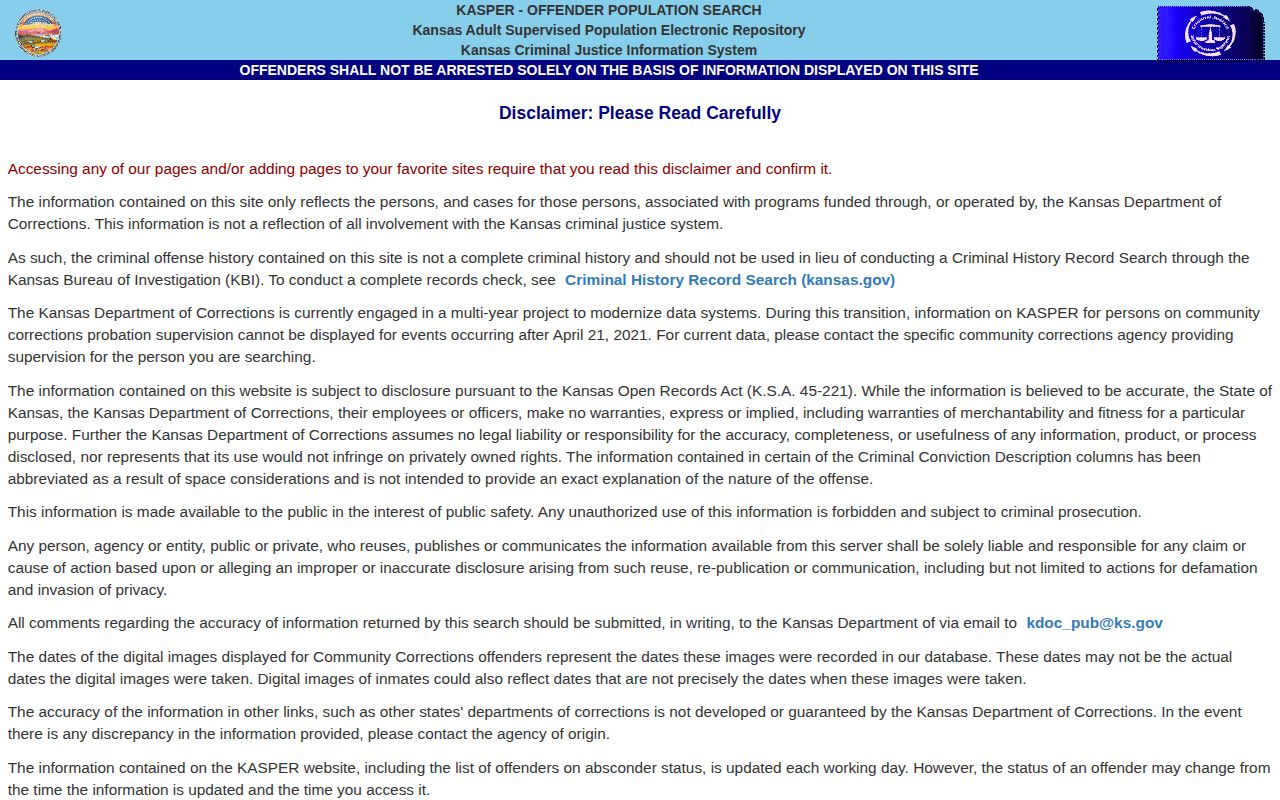
KASPER updates each working day, so a physical event can precede the display. A prison or incarcerated status points to present KDOC confinement. Parole or postrelease supervision means prison custody ended but KDOC supervision continues. A sentence-discharge or maximum-sentence date is the stronger endpoint for the displayed state obligation. Questions about a computation should go to KDOC, and data errors can be submitted in writing to kdoc_pub@ks.gov.
Pottawatomie Jail Release Computation
KASPER does not calculate a county-only jail sentence. For Pottawatomie County Jail, start with the sentencing journal entry and any court-awarded confinement credit. K.S.A. 21-6815 governs sentence commencement and court credit in the state framework. The jail then applies the lawful computation that fits the order and custody episode.
No official Pottawatomie County good-time percentage, weekend early-release rule, or local computation policy was found in the source set. Do not import KDOC’s prison percentages into a county calculation. Contact the jail at 785-457-3707 for current operational direction and use Sheriff Records at 785-457-1589 for an existing release or computation record.
The court record and jail record answer different questions. The journal entry shows the term and credited confinement ordered by the judge. The sheriff’s prisoner calendar, required by K.S.A. 19-1904, includes the date and cause of discharge. A request should identify the person, booking date, case number, and the exact booking episode so staff can locate an existing record rather than create a new explanation.
A useful request asks for the current jail release calculation, the prisoner-calendar entry, and any later movement or discharge sheet that already exists. If another authority is expected to take custody, ask whether a receiving agency or destination is recorded. Sheriff Records publishes pickup, mail, and fax routes and does not state an email channel. A calculation supplied before release should still be checked against the actual discharge entry afterward.
Kansas Good Time Release Rules
K.S.A. 21-6821 generally permits maximum good-time credit of 15 percent of the prison portion for many guideline cases involving crimes committed on or after July 1, 1993. That rule produces the common phrase “serve about 85 percent.” It is a shorthand, not a promise. The sentence, offense date, severity level, conduct, and statutory category control the calculation.
The same statute allows up to 20 percent for specified lower-severity nondrug and drug categories, depending on the relevant dates and severity levels. Eligible prisoners can also receive up to 120 days of program credit for successful completion of designated education, vocational, treatment, or other risk-reduction programs. Eligibility limits apply, and completion of sex-offender treatment itself does not earn that program credit.
Good time must be earned and retained. Misconduct can cause credit to be withheld or forfeited. For specified sexual offenses, retained credit deducted from prison time may be added to postrelease supervision. Earlier physical release therefore does not always reduce the full span of KDOC control. A person on postrelease has left prison but has not reached final sentence discharge.
Note: The 85-percent phrase is a starting clue, never a substitute for the person’s KDOC sentence computation.
Why Kansas 85 Percent Varies
Pottawatomie cases can fall into several Kansas sentence systems. K.S.A. 22-3725 addresses good time for offenses before July 1, 1993. K.S.A. 22-3717 separates parole eligibility for older or off-grid sentences from mandatory postrelease rules that follow many current determinate sentences. A parole eligibility date marks when review may occur. It does not guarantee a Prisoner Review Board release.
Mandatory hard terms, older indeterminate rules, offense-specific exclusions, 20-percent categories, program credit, and lost credit can each produce a date unlike the simple 85-percent estimate. Consecutive sentences can also extend the calculation, while concurrent sentences run together subject to the controlling terms. The offense date and sentence structure must be read before selecting the right rule.
This is the distinctive Kansas computation issue. A projected date should be quoted from the responsible record, with its exact label, rather than reverse-engineered from the sentence length alone. When the record is unclear, request the computation from KDOC or compare the Pottawatomie court judgment with the county jail’s existing calculation.
Pottawatomie Release Dates Can Change
A projected release date can move before the event. Some changes alter the sentence calculation. Others leave the date intact but prevent return to the community. The record should reveal which kind of change occurred.
| Factor | Possible effect |
|---|---|
| Corrected jail credit | Changes credited confinement and can move the computed date. |
| Earned or forfeited good time | Moves a KDOC anticipated date within the applicable legal limits. |
| Program credit | May reduce eligible prison time by the amount lawfully earned. |
| Amended or new court order | Can change the sentence, credit, or authority for custody. |
| Concurrent or consecutive terms | Changes how multiple sentence periods relate to one another. |
| Detainer or another sentence | May cause transfer to another authority instead of community release. |
| Parole Board action | Can affect older or indeterminate cases where release is discretionary. |
A detainer is a request or legal basis for another authority to take or hold the person. It does not necessarily change the sending agency’s sentence date, but it can change where the person goes that day. An appeal, revocation, data correction, or later case can also alter the visible status. Confirm the most recent court and custodian records before relying on an old calculation.
Parole action applies only where the sentence permits discretionary board release. Many determinate Kansas sentences instead lead to mandatory postrelease supervision after the prison portion. A board hearing date or public-comment listing is therefore not a projected release date, and appearance on a hearing list is not proof that release was granted. KASPER should be checked after any decision, with a KDOC records request used when the public status does not explain the outcome.
Confirm Pottawatomie Actual Release
After a county date passes, request the sheriff’s discharge or movement entry and check the court docket for the legal authority. After a KDOC date passes, read the later KASPER status and movement record. A parole-office assignment means release from prison to community supervision, not final discharge. Complete discharge is tied to the sentence-discharge or maximum-sentence record for that state obligation.
For a pending Pottawatomie County Jail custody change, the Pottawatomie County VINELink check can explain how to register for notice. Kansas VINE excludes KDOC prison inmates, so state notification uses KDOC’s separate victim-services process. Neither alert system proves the complete release cause.
When another custodian appears, verify there. KASPER covers a transfer into KDOC. BOP covers federal prison records, and ICE maintains its own detainee locator. Search systems independently because one agency’s release may be another agency’s admission. The actual destination is often as important as the planned date.